
A peeling finish on a patio chair. An old coating on a set of wheels. A metal part you want to restore in a different color. Before applying a new finish, you need to decide what to do with the coating that is already there.
If you’re wondering how to remove powder coating, common methods include abrasive blasting, chemical stripping, and controlled thermal stripping. The right approach depends on the metal substrate, and the ability of that substrate to handle a particular stripping process, the condition of the coating, and what you plan to do with the part afterward. Each method has limitations, especially when working with heat-sensitive materials or detailed parts. Learn more about powder-coating removal methods.
At American Dry Stripping, we help customers assess their metal restoration projects and prepare surfaces for their next finish.
When Should You Strip Old Powder Coating?
A color change does not automatically mean a part needs to be stripped to bare metal. However, removal becomes more important when the existing finish is compromised in some way.
Signs that a coating absolutely needs to be removed to a clean white metal blast (NACE1/SSPC-SP5) finish prior to recoating:
- Peeling, flaking, or areas where the finish is separating from the metal.
- Blistering or corrosion beneath damaged sections.
- Multiple coating layers that affect fit or obscure details.
- An existing finish that is incompatible with the proposed new coating.
- Defects or missed areas on a previously powdered coated part.
Removal of previously coated substrate is also necessary when the project’s finishing requirements call for preparation directly on the bare metal. The decision should account for both the old coating and the requirements of the replacement finish. See this professional overview of stripping and recoating.
How to Remove Powder Coating
Abrasive Blasting
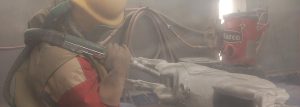
Abrasive blasting, often called sandblasting or media blasting, uses compressed air at a correct PSI propelling the abrasive material at the substrate to remove an existing finish and prepare the surface.
American Dry Stripping uses dry abrasive blasting to remove coatings, rust, and other surface contamination. The process also creates a surface profile that helps the next coating adhere. Learn more about our sandblasting and surface preparation services.
The blasting approach must suit the part. Removing a coating from an intricate furniture frame presents different challenges than preparing a heavy steel component. Material, thickness, shape, and the desired finish all matter.
Controlled Burn-Off Cleaning
For suitable parts, thermal cleaning can help break down an old coating before blasting.
At American Dry Stripping, our burn-off cleaning service uses a controlled pyrolysis burn off furnace to remove coatings and contaminants from appropriate steel and iron items. Follow-up blasting removes remaining ash and prepares the surface.
This process is not appropriate for every metal or assembly. A method suitable for an iron component should not be assumed suitable for an aluminum wheel. Burn-off cleaning requires specialized equipment and an understanding of the part’s metallurgic properties and gauge thickness.
Chemical Stripping
Chemical stripping uses products formulated to break down or release a coating. Compatibility matters: a product that removes powder coating from one material may be unsuitable for another.
Chemical handling, proper PPE (Personal Protective Equipment), ventilation, and waste disposal also need consideration. This is one reason to discuss the complete project with a finishing professional before choosing a removal method. Chemical stripping is one industry option; the appropriate process depends on the particular part. Read about the methods and their limitations.

Can You Paint Over Powder Coating?
In some cases, yes. An existing finish may be suitable for repainting after appropriate cleaning, preparation, and compatibility checks.
However, applying paint over a failing coating leaves that weak layer underneath. Before deciding to repaint, assess the condition of the existing finish and follow the proposed coating manufacturer’s preparation requirements.
Recoating procedures vary by coating system. Manufacturer guidance may call for sanding, cleaning, adhesion testing, or a specific repair system.
Can You Powder Coat Over Powder Coat?
Sometimes, but it requires more than applying another layer.
Because powder coating is an electrostatic process, it is important to assess the number of previous coating layers applied. Powder coat material is an extremely effective insulator. An inability to get an effective polarity across a part will result in poor adhesion and a failed coating attempt. At this stage, it is better to simply start over and remove all existing coating prior to coating with a new color.
The old and new coatings must be compatible, and the existing finish must provide a reliable foundation. Powder coatings vary in their ability to bond between layers when recoated.
If any project presents with peeling, corrosion, or an uncertain coating history, there is no choice but to remove the affected finish and strip down to bare metal.
What Happens After the Old Coating Is Removed?
Removal is one stage of refinishing. The exposed surface still needs inspection, cleaning, and preparation for the selected finish.
Stripping may reveal pitting or other damage that was hidden beneath the coating. Discuss those findings before deciding how to proceed. A new finish changes the surface; it does not replace missing metal or repair a weakened component.
This is also the time to discuss the item’s intended use, preferred appearance, and areas that must remain uncoated.
Start Your Metal Refinishing Project With American Dry Stripping
Whether you have outdoor furniture, automotive parts, or another metal item, start with an assessment of its current condition.
American Dry Stripping provides stripping and surface preparation services in Milford, Connecticut. To help us understand your project, send photos, the number of items, and their approximate dimensions. Include any concerns about peeling, corrosion, or previous refinishing.
Contact American Dry Stripping to discuss removing the old finish and preparing your metal for what comes next.